Showing posts with label creative process. Show all posts

Friday, August 05, 2016

Pain of Procrastination


For a long time, I have struggled. I am not ashamed. I know I am not the only one. The fact is, procrastination in painful. Most of us do it. And most of the pain of procrastination is self-created.

Like so many things, there's no easy answer, no bypassing it. The only way is to practice, practice, practice - working with awareness, knowing your own creative ark, asking for help, and persevering.

For me, procrastination mainly appears when I am struggling through the middle of a project. It gets strongest when I reach a plateau of some sort - a sense of "Whoa. This is good. Hey. I can do this." Then I want to coast, or want it to be done with entirely. I start to doubt everything - can I really do this? Is it worth it? Am *I* worth it?

In other words, the only parts I really enjoy of a project are the beginning (Yippee! This will be fun!) and the end (Ohthankfuckinggod). Keeping going in the middle is the hardest part, and where most of us fall apart.

So why bother?

Thursday, October 29, 2015

The Trap of Doubt, Delay and "Discipline"


Recently, I met with one of my writing feedback groups. Most of the folks in this small group are working on memoir, which is a supremely difficult genre. One woman in particular is writing a very hard tale about a very small but potent part of her life - a year or so of mental health struggles in which she lost most of her support network. It's a poignant story, and she tells it very directly.

Since she has begun, she's written with great momentum, clear about what comes next, able to pile through very tricky scenes with great ease. Then she hit some doubt - a moment of not being sure where the story was going next, or what the point was in writing/sharing it. And then she hit some stress - way too many external and internal stressors coming together at the wrong time. Her actually writing got delayed - put on the back burner - by a few months, due to illness and literal, physical inability to write. It's also inevitable that such an intense story would bring up doubt, eventually.

Thursday, June 12, 2014

What Writing Looks Like

Procrastination.
Evasion.
Deadlines and then reaction.
Writing.
Crying.
Banging head against manuscript again and again.
Breaking through: writing.
Time is up, drop it again.
Come back.
Try to write again.
Crying.
Writing.
Deep joy and relief, thank you thank you thank you gratitude.
Calling on friends to read and for support.
Going for walks.
Writing.
Yoga.
Writing.
Editing.
Writing.
Editing.
Crying some more.

Sunday, February 17, 2013

Seduced? Deduce and Reduce to Produce

NYC April 2010
In the past, I have spent a lot of time wondering how/why it is that we are so divided so much of the time. I am not speaking of culturally, racially, class-wars or the like (though perhaps these thoughts do scale) - I am speaking of the inner wars so many people struggle with: inner critic(s) versus inner child; wanting to establish better habits but being held back by older habits, etc.

I am at the point of saying in my process that I have had enough.
I am still curious about what is going on in there, but I am sick of feeding the distraction through evaluation. For me, I've reached a point where asking all those questions more often than not leads me right back into the loop of the debate again and again. I get stuck. Enough.

Asking those essential questions: 
Why do I believe this? 
Who helped me to believe this?
What is the logic beneath this belief?
Is still important to me. However, they can, just like any other wisdom allowed to languish for too long, lead me right back into not doing what it is I wanted to do, or even be, in the first place.
In other words, the inquiry itself can stall me out - it's an extended tactic of my own resistance.
Even curiosity can hightail me right back into fear, if I allow it to keep going for too long.

Last night, as I was falling asleep, I thought about seduction. The seductive power of my old habits and beliefs. Coming home from a long day of teaching, all I wanted was to "space out." A big part of me said "Please meditate and do yoga, that is good self care." Another big part of me said, "Dude. You worked all day. Those are work. Just watch some TV."

Luckily, maybe because I was teaching and participating in a writing critique session, the meditation part won out, even if I did it with bad posture while snuggling on the couch with Dylan and Aviva. The meditation gave me an opening, some space to realize I really wanted to do yoga, too. So I did.

But more often than not, I give into the seduction of these beliefs. I may even get so far as to ask questions about it, catching on to the debate inside and not believing habits right off the bat. A normal interchange for me would look like this:
"I'd like to do yoga and meditate."
"Yeah, but, it's work, you know? You deserve rest."
"But yoga and meditation are self-care."

"Nah. When you have more energy. Tomorrow, maybe, eh?"
"I said that yesterday. And the day before."
"See what a pain in the ass this is? Let's just go watch some TV. Don't stress yourself out."

BUT where does the stress ACTUALLY COME FROM? 
The voice. The debate. The questioning.
Not the yoga or meditation.

The habits are seductive. I want to look at those voices with more suspicion, more wisdom. And by looking at them, I mean taking a step back and watching them try to convince me that the old way is the best way. Like a bad lover I don't even want to sleep with anymore, but I keep returning to because at least I am getting laid, which means I am cared for, in some strange logic.*

Therefore, as I thought about the word seduction, the word "deduction" came into my head. Then "reduction," and finally "production." 

I am not normally a fan of "Here are the ten steps to productivity" kinds of posts, but frankly, for me, I am needing some bullshit cutting tools for when the same things come up again and again.
I *know* where the logic is going.
I don't need to inquire anymore, show respect,  be curious.
I need to take care of myself.

I knew from Mr. Lee's 9th grade English class, where we studied Latin roots until we were blue in the face (Thank you, Mr. Lee!), that the root "duce" means "to lead."
This morning, I looked up the original roots of the words' prefixes when combined with "duce":
Seduce literally means to lead away from.
Deduce means to trace the path of. 
Reduce means to lead back. 
Produce means to lead forward. 
That's some powerful etymology, as etymology often is.  

Instead of thinking of seduce as "sinful" as in "leading away from a good marriage" (more like it's usage is now) we consider what it is leading away from - the things, in my case, I *know* are good for me and are not really up for debate - ie - I am not debating whether or not they are good for me - then this process looks like this:

When my thinking begins to lead me away (seduce) from yoga/meditation/etc, I can pick up on its path (deduce). I don't have to follow it all the way to its end - simply bring it back to the good habit in question (reduce). Then I can lead myself forward again (produce), from the root of my desire to do this thing I no longer question - yoga, meditation, etc.

This requires making a list of what you know are "non-debatables" - for me - calling a friend when sad, writing practice, yoga, meditation, exercise. As soon as I feel a tug away from doing any of these, I can actually begin to pay attention - there is NO REASON not to do any of these at any time, unless there is serious conflict (injury, emergency, deadline that is imminent or Dylan needing my help) going on.

What are your non-debatables?

What can you do to call attention to helpful inquiry (really being curious) and seduction (getting caught up in a pattern of thinking that actually won't lead to clarity)?
Do these words do it for you, or would you need a different set? If so, what?

This four-word list is going up on the wipe-off board in our bedroom where we keep word sets or questions, "Please meditate and do yoga" type requests from our bodies so that we don't forget the essentials.

*Um. That's not just an analogy. I am writing a lot about doing that kind of thing in my memoir from ages 12-28.


Tuesday, February 12, 2013

Juicy Anxiety

Collages by Cathy Riddle at Shambhala Art Part II, February 10, 2013
This last weekend I taught, for the very first time, the full curriculum of Shambhala Art Parts I+II. I was trained in LA over a year ago to teach this, and Part III. I attended a retreat this January, and that finally made me feel ready to teach a whole weekend. In the meantime, I had presented parts of it at a week-long Arts retreat with Lisa Stanley and done a talk and exercise in Paris in June of 2012.

I was, needless to say, but I'll say it anyway, nervous as fuck. Super anxious. I mean, really.
I teach full-time. I teach in all sorts of circumstances with strangers. And yet. Not having taught the material yet in public means, for me, that it isn't "mine" yet. A lot of the teachings in Shambhala Art overlap with Miksang and the way I teach Contemplative Writing (because the core text, True Perception, by Chogyam Trungpa Rinpoche, is the same). But the terms are different, the exercises different. Those are what didn't feel mine yet.

My familiar ground quickly became my students' anxieties. Yes. Not just mine, but theirs.

I don't mean that in any kind of sadistic way ("Oh yay! They are suffering! That's good! I can work with that!") but rather that this particular sweet set of five really opened up quickly and let it be known that they, too, were nervous. Nervous about doing exercises they don't know. Nervous about their bodies and about speech, introducing themselves, moving spontaneously in front of one another. Drawing. Speaking spontaneous poetry. Trusting one another as, in pairs, a sighted person led a blindfolded person around. A combination of every leadership retreat meets art retreat - at least one exercise triggered or intimidated everyone, and most, including myself, found nearly every exercise challenging.

And yet, strangely compelling.
I say strangely because normally we don't go towards anxiety. It sucks. Why go there? The students, granted, 4/5 knew me as a teacher, but still - the students trusted me. They quickly trusted each other and even started to trust themselves. Immediately we could all see what that trust brought forth - moments of total clarity, pure inspiration, in the middle of complete and consuming anxiety or distraction.

Inter cut. Inter twined. Inter dependent. While it is so tempting to say, to think, to look for messages that reiterate that inspiration and anxiety are, and should be, completely separate states, they aren't.
No way.
Let's face it.
I know very few people for whom even their most practiced artistic endeavor does not cause them at least momentary panic attacks each time they approach it. Not to mention "regular life non-art endeavors," though Trungpa would categorize everything we do as art. It happens. Shit happens.

And it turns out, no matter how many times we hear it we can't seem to hear it enough, lotuses grow out of mud. Compost is rotted vegetable matter that brings out better blooms. Manure is fertilizer for hearty crops. Going into the anxiety, with acknowledgement, gentleness and even some playfulness, is the only way. No sidetracking, no distraction will access the juice just waiting to be squeezed out of resistance.

Though I have quite the internal dictator, or perhaps because I have quite the internal dictator, I find it very important to distinguish here - sometimes we do need a break. A real honest breather. Some space. A walk in the woods away from the overdue article. A crying festival with a friend to process what's underneath not wanting to pick up the pen. Playing with another media, one with less tension associated with it, until you can relax enough to rediscover inspiration. I am not implying that dogged pursual is the way, all the way, 100% of the time.

But when we take space to rediscover, access what Trungpa calls Square One, and First Thought, we need to be honest about whether we are trying to escape or getting some space. Because anxiety knows. It is clever. And if we run away, it will hunt us down. If we are simply getting space, we discover that even in the seemingly solid intensity of anxiety, there is breathing room. Anxiety, nervousness, intensity - all of these and more grow in the darkness, in being ignored or avoided. Not the kind of growth that inspires - the kind of growth that chokes.

Don't take my word for it. Please. Turn on your bullshit detector and go out and test out what I am saying. Next time, instead of doing the same thing you always do (and we all have deeply ingrained habits around anxiety, especially in "making art"), try something new. Engage in a dialogue with your anxiety. Write down what you are really feeling. Pick up a brush and paint an entire black page before returning to your delicate watercolor. Let juicy anxiety and inspirational intensity dance with each other. Find the soft spot of fear, sadness, anger underneath and let it show you what it has to say.

I guarantee it won't be what you expect. It will be fresh. Real. Honest.
The best inspiration we can ever ask for.


Monday, October 08, 2012

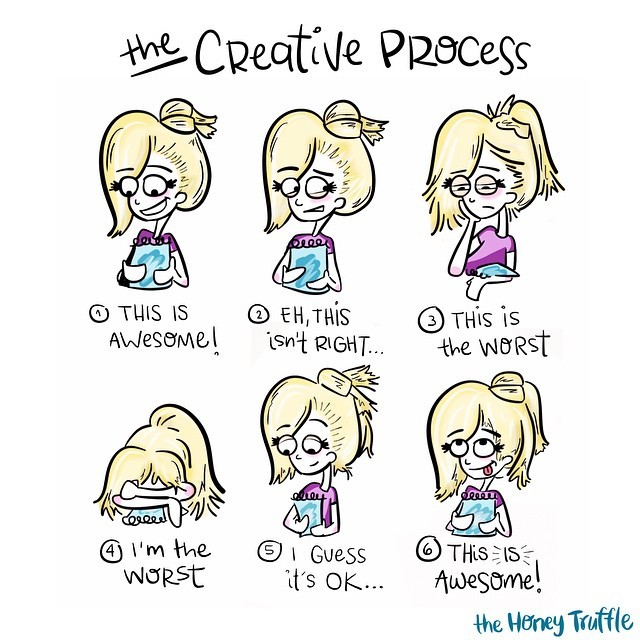
React V. Create


In an article titled "Overcoming Writer's Block Without Willpower" in Writer's Digest, the November/December Issue yet to be online, Mike Bechtle posits that we can work with neuroscience to understand how to better negotiate Writer's Block. What he juxtaposes is the mind that creates (fresh ideas, openness, concentration) versus the mind that reacts (our source of willpower and distraction). Reacting mind is reiterated, exasperated, by our "modern world" - we "react" when we go to our phones to see if anyone called, ditto email, Facebook, etc. This reaction mind inhibits creativity. So far, so good. I agree, and really like the framing.

However, he goes on to state that removing technology will really help us to sink back into more time to think, more space in which creativity naturally happens. He points to it, but never actually goes that far: the source is there all the time, available, but we overlook it. However, he does not even address how to cultivate a connection, not just how to cut off distraction.

Monday, August 27, 2012

Why We Suffer

Honest Ed's, Mirvish Village, Toronto, ON
"If it is so beneficial, and I know it is, from experience, to not know what is coming next, to allow ourselves to open directly to the world and be present with what our senses deliver, then why don't we do it more often? No, even more importantly - why is our culture so against it?"

A question from the last Way of Nature class at Olbrich Botanical Gardens this last Sunday. I've gotten this question before in so many ways - from people learning about meditation, contemplative writing, contemplative photography, and, in this case, Haiku.

Another student answered something about our culture - about America and its materialism. Another about a fear of getting hurt. The whole time, I was drawn to the dry-erase board, where I came back to an earlier discussion about suffering, the Four Noble Truths and what it means to truly have no reference points.

"We don't, our culture doesn't support it, because it seems scary as shit," I said, once the other discussions had died down. "Not just us - everyone avoids it - it's pan-human behavior. It's suffering."

Saturday, May 05, 2012

Taming the Tamer

Still from the tiny film Taming the Tamer (link below)

Here is a tiny silent paper-cut animation film I made a couple of years ago.
It is about taming the inner critic, though it often attempts to tame the good, while wild, parts of us.
I am in the process of setting up a more thorough YouTube channel, so I can share videos of my own, audio for students, and obviously suggest great talks and other resources on YouTube. I'll keep you posted! In the meantime, enjoy this little film.


Wednesday, December 28, 2011

Homage to Bass

 (image is mine - my brother Alex Hall used it as the cover for his EP of the same name)


The chances of me waking up, getting out of the shower, coming home and hearing Bass are very strong. If Dylan's in a good music mood and willing to chug out the beats, this is what will greet me. The funny part is that this has been a likely opportunity since I was thirteen, not just in the last five years.